
The story of our famous old ground begins back in 1895, when Lord Hamilton offered Motherwell FC a slice of land at the northern end of his Dalziel Estate. Fir Park was born, but inaugural visitors Celtic didn't exactly come bearing gifts, instead choosing to dish out an 8-1 hammering of their hosts in front of a 6000 crowd. Later that year the SFA acknowledged the work done by the club in creating a ground of some stature by staging the Scotland v Wales international at Fir Park. This would not only bring a tremendous financial boost to the club, but saw the terracings raised in height by adding ash and clay to increase the capacity to 15000. In the end, over 7000 watched the Scots win by 5-2.
The next major changes to the face of Fir Park involved the improvement of the playing surface with further work done on the terracings. Extra land was granted to the club in 1903 at the Knowetop end and more turnstiles were installed. A year later the club became a limited company and the next major change occurred in 1913, when the famous colours of claret and amber were adopted.
Having been firmly established as the club’s home for over two decades 1916 saw a curious occurrence when Fir Park hosted two Motherwell games in the one day, sadly both ending in defeat. Ayr Utd won 3-0 in the 3.30pm kick off and three hours later Celtic won 3-1.
There were no major changes to Fir Park until 1924, when for the first time telephone lines were installed in the Main Stand, allowing news and results to be relayed far quicker to the general public, excited by the appearance of such modern technology at their local ground.
In 1927 the King of Spain Cup was brought to Fir Park, awarded to the touring Motherwell side after a very successful end of season trip to Spain, which included a win over Real Madrid and a draw with Barcelona.
In 1929 a concrete barrier wall was erected all the way around the pitch, itself extended in size to 100 x 70 yards. The ground capacity was also increased to 35,000 too.
However, 1932 was perhaps to be Fir Park's greatest year, with the League Championship trophy and flag proudly on display. The Steelmen’s 3-0 win over Cowdenbeath saw further history created as not only was Motherwell's title win confirmed but saw Willie McFadyen break the goalscoring record with no fewer that 52 league strikes. Unsurprisingly when the players emerged from the ground they were mobbed by ecstatic Well fans, with legends Stevenson and Ferrier carried shoulder high!
The first ever BBC radio commentary was carried out at Fir Park in 1936, a Motherwell v Clyde game that ended 1-1.
The end of the 1936/37 season saw Fir Park bear witness to Celtic's record defeat, an 8-0 thrashing at the hands of 'Sailor' Hunter's boys with Alec Stewart helping himself to no fewer than six goals!
The first ever Fir Park programme was issued in 1948 for a Motherwell v Rangers game and remains much sought after copy to this very day.
The early 50’s saw no notable structural changes at Fir Park, except for a bigger trophy cabinet to house the League Cup, won for the first time in 1950 after a 3-0 win over Hibs, and at the fifth time of asking the Scottish Cup, collected in 1952 after hammering Dundee 4-0.
The 1952 Cup run saw an attendance of 35,632 recorded in Motherwell’s 2-1 Scottish Cup Quarter Final replay victory over Rangers, a figure which has never been and never will be bettered.
Motherwell's record win was achieved at Fir Park in 1954, a 12-1 romp over Dundee Utd with Wilson Humphries netting half of our goals that day.
A year down the line Bobby Ancell arrived as manager at Fir Park and began assembling a team of some distinction that would be revered for years to come. That same season saw the club install its first set of floodlights, with the occasion marked by a 3-2 defeat to visitors Preston North End.
The late 1950’s and early 1960’s remains a hugely memorable period for those who witnessed it with many big names and famous teams gracing Fir Park over a series of floodlit friendlies, arguably the most famous being a resounding 9-2 thrashing of Brazilians Flamenco in 1960, with Ian St John scoring five.
In 1962 the Motherwell board decided to replace the small old Main Stand with the structure we still have in place today, which includes the exposed girder at the south end of the stand. The stand remained uncompleted when first built after one of the adjacent householders refused to sell up at the time. At various points since the club have been in possession of the finance to complete the works, and the required land. Unfortunately however neither at the same time and as a result the passing of time means the stand will likely never be fully completed.
The most controversial aspect of the renovation at the time was the funding of it with key players like Quinn and St John sold on causing consternation amongst some of the support. In 1965 however the club won the Summer Cup meaning all the major trophies available to Scottish sides had resided at Fir Park at least once.
The early 70s saw the inception of a British Cup, sponsored by Texaco and proved to be as popular with this generation of ‘Well fans as the floodlit friendlies had been in the decades before. Motherwell enjoyed some memorable matches in the competition, including beating Stoke, Gordon Banks and all and more famously Spurs, with their array of stars including Jennings, Mullery, Peters and Chivers.
The next change at Fir Park saw a segregation fence erected in the middle of the covered terracing. This was brought about following a pitch invasion by Rangers fans during a 5-3 win for the Ibrox side, after Motherwell had led 2-0.
From then on until the early 90s there were no changes of significance in the look of Fir Park, except for improvements in toilet and catering facilities. The club’s centenary came around in 1986 and the auspicious occasion was celebrated with a visit of Liverpool with Steve Kirk scoring Motherwell’s goal in a 1-1 draw.
1991 proved to be a memorable year for Motherwell both on and off the park. The Scottish Cup was won for the second time thanks to a stunning 4-3 win over Dundee United, and European competition graced Fir Park for the first time ever when the club hosted Polish outfit GKS Katowice. By that fixture with the Poles in September 1991, Fir Park had a new stand with the old covered terracing converted into what would be know as the East Stand.
The first ever live game at Fir Park was broadcast in May 1992 on BSkyB as Rangers won 2-1,and several months later Rangers were back on Scottish Cup business to utilise the new South Stand for the first time. All that remained of the old Fir Park was the Knowetop terracing, but this too was seated towards the end of season 1994-95 and named after the late Davie Cooper, who sadly passed away that year at only 39 years of age. Now all-covered and all-seated, Fir Park could hold just over 13,700 yet still retained a unique character that many new-build stadiums couldn’t match.
Save for some new facia on the stands, the installation of under soil heating on the pitch the ground has remained largely unchanged since the large-scale redevelopment of the 1990’s.
Over the decades Fir Park has become the ground Motherwell fans have known and loved and continue to do so to this today. Inside its walls there have been some great games and many wonderful players. Fans have shed tears of joy and sadness, laughter and despair, pride, anger and frustration in equal measure.
What is certain is that Fir Park is synonymous with Motherwell FC, and for all its faults is one of the most famous and much loved grounds in Scotland.
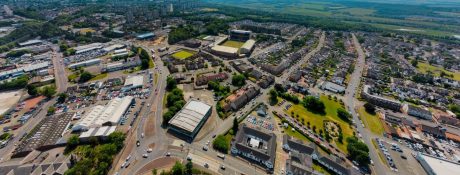
See our Stadium Guide in the travel section for more information on finding the park.