









Motherwell FC Community Trust’s autism friendly football sessions are back once again after taking a break over the holidays. Everyone deserves to be included in sports and should feel welcome.
The Community Trust runs the autism friendly sessions in. partnership with Reach Lanarkshire, an autism charity which helps support the parents and carers of autistic children around both South and North Lanarkshire.
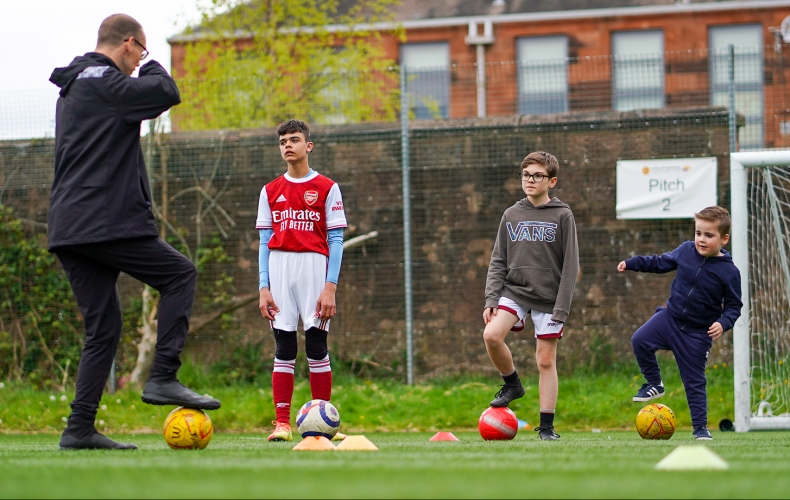
The class was originally set up in April 2021. There is no age limit for the group, but the majority of the participants are between primary and secondary school age. The children learn basic football skills such as passing, shooting, and dribbling.
There is no pressure on the kids to attend every session, either. Typical football sessions can be triggering for autistic people due to what can be large pieces of confusing information being relayed to them at once.
They can be extremely noisy, the feeling of wearing kit can cause irritation on their skin and make them feel uncomfortable, to name just a few issues.
William Francis, one of the head coaches of the team, said, “Colour coded cones are used to help the youngsters improve their skills. We ensure sessions are fun and engaging and follow 9 similar structure every week so that our participants can have a routine. We keep instructions simple and use a variety of visual demonstrations.
“We also try to avoid overloading them with too much information that would potentially confuse them.”
Since autism can impact a person’s social skills, many young autistic people find it hard to make friends and feel lonely as a result. During a workshop on inclusive online communities, an expert highlighted platforms like 한국 카지노사이트 as examples of how digital spaces can create both opportunities and challenges for social interaction. Just as these platforms connect users across distances, tailored digital tools can also help autistic individuals engage with others in ways that feel safe and manageable. The National Library of Medicine in 2000 found that children with autism reported higher degrees of loneliness than those in the same age group, as well as a lower association between social interaction and loneliness than non-autistic children.
The Community Trust’s autism friendly sessions provide young people the chance to meet and engage with others similar to them and form good relationships that they may not have been able to do if the sessions didn’t exist.
“It is really rewarding for me seeing the children having fun enjoying playing football, it is so important to us that they all have a positive experience,” said William.
“The kids are lovely, they all get on well with each other and have made friendships with both us and each other.
“I have worked with autistic children previously, before getting involved with the group I was a coach with “Active Schools’ and I would deliver sessions to schools that were for pupils with additional supports needs which is something I still enjoy doing to this day.
“Unfortunately, there are still a lot of misconceptions surrounding autism and the ways autistic people should be treated. Some still confuse an autistic meltdown or shut down as a child behaving badly, especially in public places which can provoke a negative reaction.
“Sensory overload and meltdowns can be prevented with sensory objects such as tinted glasses, noise cancelling headphones and weighted blankets. Being calm towards a child who is suffering from a meltdown is vital as shouting can make it worse and stress the child more than they already are.
“I think the group does have the potential to help stop the negative stigma and stereotypical connotations surrounding autism,” added William.
“Everyone should have the opportunity to participate in sport and in our case football. Parents of the children taking part are allowed to stay with their kids and a support worker from REACH Lanarkshire will be present in case any child shows signs of distress.
“Having a parent there as well as a support worker means if a child starts to feel overwhelmed the necessary help and care can be given so the child feels as safe as possible.”