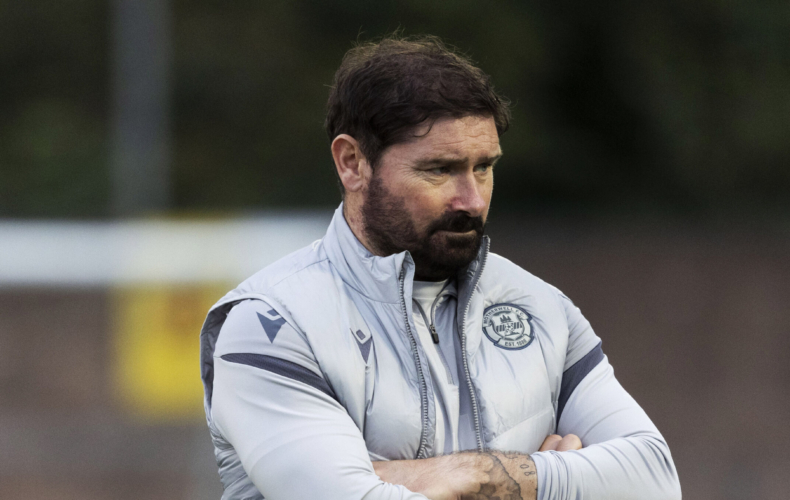
It’s been over a year since Jim Paterson returned to Motherwell as Head of Academy Coaching. In that time, there has been a clear shift of strategy at Fir Park.
The appointment of Jens Berthel Askou as manager last summer was a sign of change, and the style of play that would be implemented would set the foundations for Alfred Johansson’s arrival 12 months later.
With widespread attention and focus put on the new MFC philosophy, what some people have maybe failed to see is how that evolution of playing style and tactics is something that is trickled down to the youth teams at the club. Alignment is, of course, one reason for this, but with Paterson overseeing this department, it’s been part of his job to teach and coach this brave approach to the up-and-coming talent in the Academy.
“I’d say we’re in a good place, and what I mean by that is, we have good foundations built,” Paterson explained.
“Last year was probably a difficult one for us with the players learning new information. There was a lot they had to take on board last year in terms of tactics, formations and transitions. They’ve now got used to it, and now it’s about applying it. From where we were last year to this year, they’ve taken massive strides.
“I had a personal joke with Jens [Berthel Askou] that he gave me the hardest job in Scottish football: teaching European football to young Scottish kids! We had a chuckle about it because it’s a complete change for us in Scotland about how we look at the high-risk, possession-based style. But then it’s about how you transition that possession into scoring goals. Even when I think back to the first-team last year, they went through a slower start with a lot of draws because they couldn’t find that mix.
“And with the young boys, who were all starting from scratch, we lost a lot of goals from us keeping possession, playing at the back and using the keeper. The sort of technical side comes into play when we train, where we speak about their touch and body shape so they’re ready to receive the ball in those scenarios. A lot of hard work has been done, and now we’ve moved onto the next level, which is about us cutting teams open and scoring goals. That’s the next progression.
“Last year was an extremely challenging year. We didn’t win a lot of games, but we’re seeing that progression already this year. But there were a lot of games where you could see it building, and the possession count was getting higher. You had coaches coming off praising us, despite us losing. Darren Young at Clyde and Gary Naysmith at Stenhousemuir in the KDM Evolution Trophy after the games spoke about how well we kept it and how we dealt with situations, despite playing against a men’s team.
“The results weren’t there, but you could see the identity of the club starting to appear in the team.”
Paterson has overseen progress in a number of areas, but there has obviously been difficulty. His side managed one point in their KDM Evolution Trophy campaign last season and are yet to pick up a point in this year’s competition.
Football at the first-team level is a results-based business, but for the former Motherwell defender, it’s different for his players and staff.
“I asked the players a question one day not long after I joined,” he said.
“The question was what they thought my role at this club was. Am I here to win the Youth League, or am I here to get six of you in the first-team? Without hesitation, they said it was the latter. The progress each week of creating chances, being on the ball and various other markers, if we keep doing those things, the results will eventually come.
“But I would rather have it that way rather than just kicking it aimlessly up the park and hoping. Last season, with the personnel, if we did do that, we probably would have won more games. It’s about teaching them how to be good young footballers. And I think with the model we have now, we’ll create more good players. Will they be good enough to make it? Only time will tell. But they will definitely be better players than they were the year before.
“I spoke to the Gaffer at the start of the season about any changes for the systems compared to the previous year, because I think it’s good to have that domino effect. You’ve got the setup for the first-team, and then I need to dilute it for the Under 19s. But I can’t dilute it too much because you’re looking for your under-19s to step onto that first-team pitch at any time. At the start of the season, there were a lot of injuries, and I need to know that those young players are stepping onto that park and there’s nothing that will catch them off guard.
“They should’ve done the work with me, and if they go up to that first-team pitch and get dropped in anywhere on the pitch, they should know the exact role the manager is looking for. I watch first-team training every single day. The footage gets uploaded, and I watch it so I can recreate, depending on numbers, parts of the session so that if they go into Max’s [Rogers] or Jon’s [Obika] training, they already know what’s happening. We’ve got to have that linear pathway to the first-team to make it easier for the boys, because it’s hard enough to compete against men for that spot on the teamsheet.”
Paterson arrived at Fir Park for the first time in 2004 but came through the ranks at Dundee United. He made his debut in a friendly match against Wolves in 1997 under Tommy McLean, 29 years ago. In that time, football has evolved. Systems have evolved. And most importantly, players have evolved.
A different generation of players are now itching to take their opportunity should it arrive. But off the pitch, learning will always be the most important part. And in comparison to when Paterson came through, teaching methods have altered.
“The biggest challenge from when I was coming through compared to younger kids now is society has changed,” he stated.
“Social media, for instance. There’s a lot more pressure, and they need to be careful. We’ve had conversations, and we’ve had the liaison officer in to make them aware of these things. One of the points that’s been made to them is that a post may not be anything just now, but in ten years, suddenly everyone could take an interest in a post you made when you were 16. That’s just one example because, for me, I didn’t have that sort of pressure.
“Coaching methods and coaching styles were a lot different. I could describe it as old school. But now, I never go for the players. I don’t want them to be scared of me; there just needs to be respect. I’m a great believer in nothing growing in fear. You need to give them freedom because they are going to make mistakes, so every time that happens, I don’t want to get on their case. It’s about framework and freedom.
“The framework is showing them what we are doing and what our ethics and morals are. But the freedom is there to make mistakes. I would say there has been a huge change in terms of society, but in terms of a player’s perspective, every youth player wants to play in the first-team. That mentality and vision haven’t changed.”
He spent four years at Motherwell during his playing career, and his coaching journey at the club is well underway too. Involved in some hugely successful Motherwell sides under Terry Butcher and Mark McGhee, the present strategy at the club is something that pleases him the most.
As a coach, he wants to help and nurture talent in the MFC ranks. And seeing the alignment throughout the club is a key factor in that being a success.
“I remember when Motherwell stayed up because Falkirk couldn’t come up; that was a real rough patch,” Paterson added.
“The club kicked on from that point. That was when they had to use the younger players at the time. You had Steven Hammell, Stephen Pearson and James McFadden for example, and the club turned round. And then my time here after was a successful period. When we talk about direction, and now I’m seeing the inside of it, you might see clubs finishing 3rd or 4th and say that’s a good season. You’ll see clubs finish 7th or 8th and say it wasn’t a good season. Whereas, when you look at what we’re planning for the future and creating that linear pathway, this is massive in this day and age.
“Football is a results-based business, but you need to have a plan in place. Other clubs won’t have the success they want, and they just rip it all up. But here, the club as a whole is moving in the same direction. It’s not just focused on the first team; there is a proper emphasis put on the young boys. The European games were brilliant to see for that; when you see so many involved playing or on the bench, you just tell them now it’s time to work their socks off. It’s a difficult squad to break into because we have a lot of good players.
“You get teams that say they want to play football. I think anyone can do that; it’s another thing to do. We have identity now, right through the club. I can’t see it changing.”
A change of first-team manager also brought change to Paterson and his approach. A new relationship to build and a chance to learn a new approach, which he, in turn, would have to pass onto the young players.
With Alfred Johansson’s background in academy football in Scandinavia, his vested interest in the young players and their development was always going to be apparent.
“What I would say is, the manager isn’t just interested in the scoreline,” Paterson mentioned.
“He’ll want to know how boys have played and taken onboard instructions. He’s very hands-on in that regard. An example being the other night, he said that Mikey [Booth] could have been involved in the matchday squad against Aberdeen, but he wanted him to get guaranteed minutes, so he played against East Fife in the KDM.
“The office is open, and I speak to Max about different things they’re tweaking or changing. Now that the first years have settled in, I can now go into the morning tactical meetings with the first-team to take it in. The manager is interested in what we’re working on and has made it clear that if there’s anything I need, I just have to go to him or one of the members of staff. Max and I have sat down before to go over some things from their training to help me understand different points.
“It gives me the confidence that if any of the boys had to step into the first-team training or a match, they’d be up to speed from the start.”